

From SEU to Vienna: Attending ICRA 2026 and Exploring Robotics, Touch, and History
From June 1 to June 5, 2026, Zhao Hongliang, a member of IPCL Lab, attended the IEEE International Conference on Robotics and Automation (ICRA 2026) in Vienna, Austria. ICRA is one of the major international conferences in robotics and automation, bringing together researchers, students, and industry practitioners working on robot learning, perception, manipulation, sensing, control, medical robotics, autonomous systems, and embodied intelligence. The 2026 conference provided a broad view of how current robotics research is moving from laboratory demonstrations toward more reliable, generalizable, and physically grounded systems.
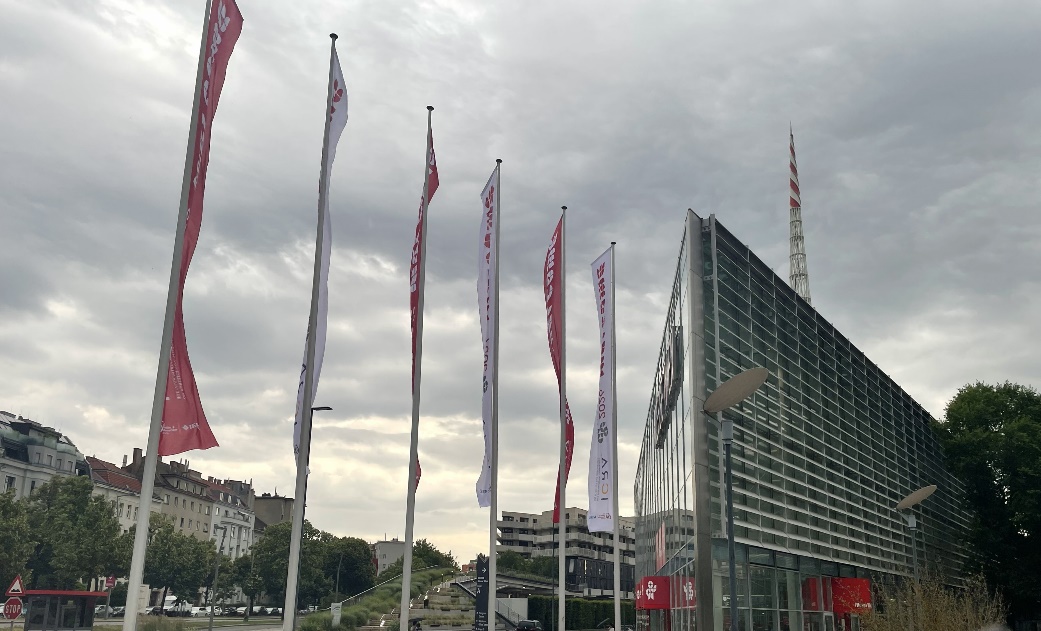
For research related to tactile sensing and robotic manipulation, several workshops and sessions were particularly relevant. The ViTac workshop focused on tactile sensing, visual-tactile perception, and embodied robot learning. A recurring theme was that tactile information is becoming increasingly important in tasks where visual observation alone is insufficient. In manipulation, many critical events occur at the contact interface: slip, pressure change, impact, deformation, contact onset, and loss of grip. These signals are often difficult to infer visually, especially when the object is partially occluded, deformable, reflective, or fragile.
One technical example discussed in this context was SpikeATac, a multimodal tactile finger for dexterous manipulation. Its design combines a taxelized PVDF dynamic sensing array with a static tactile sensing channel. The PVDF array provides fast dynamic responses to contact changes, while the static channel supplies slower force-related information. This type of sensor design is important because tactile policies depend heavily on what the hardware can make observable. For contact-rich manipulation, the physical layout of the sensing elements, their response bandwidth, and their sensitivity to local interaction can determine whether a policy receives useful feedback or ambiguous signals.

The SpikeATac demonstration also raised a practical issue in tactile robot learning: tactile interaction is often difficult to simulate accurately. Unlike vision, where large-scale datasets and synthetic rendering pipelines can sometimes support pretraining, tactile data are closely tied to sensor mechanics, surface materials, contact dynamics, deformation, and noise. In such cases, a policy trained only in simulation may not transfer reliably to the real system. The SpikeATac work therefore used tactile-based rewards and human feedback to fine-tune behavior on real hardware. In the fragile paper-tube manipulation task, the robot had to adjust contact force and motion without crushing or losing the object. This example showed how reinforcement learning can be used in a targeted way when the key challenge is not only deciding the motion, but also regulating contact through real tactile feedback.
This discussion is closely related to tactile recognition research. Zhao presented the paper “Tactile Recognition of Both Shapes and Materials with Automatic Feature Optimization-Enabled Meta Learning” in an interactive poster session. The work studies shape and material recognition using a compact tactile sensing platform and a feature optimization framework under limited-data conditions. The poster introduced the tactile sensing setup, the shape-material dataset, the feature pool, and the automatic selection process used to identify informative tactile representations. Rather than relying only on a large end-to-end neural network, the method focuses on organizing physically meaningful tactile features so that recognition remains effective when tactile samples are limited.
The poster session provided direct technical exchange with conference participants. Questions from visitors covered several aspects of the work, including the sensing principle, the difference between shape and material information, the role of feature optimization, the relation between handcrafted features and learning-based classifiers, and the possible extension of tactile recognition toward manipulation tasks. Compared with a short oral presentation, the interactive poster format allowed longer and more focused discussions. Different visitors approached the work from different backgrounds: some were interested in tactile hardware, some in few-shot learning, and others in the broader role of touch in robotic manipulation. These exchanges also helped clarify how tactile recognition research may connect to downstream policy learning, especially in tasks where object properties influence contact behavior.

The main conference also included industry exhibitions, robot competitions, technical talks, and demonstrations. These activities placed academic research next to real robotic platforms and commercial systems. For tactile robotics, this connection is particularly important. Sensors, robot hands, grippers, and learning algorithms cannot be considered separately for long. A tactile method that performs well in offline recognition must eventually face issues such as sensor robustness, wiring, calibration, repeatability, integration with robot control, and data collection cost. The conference environment made this connection between algorithms and physical systems visible.
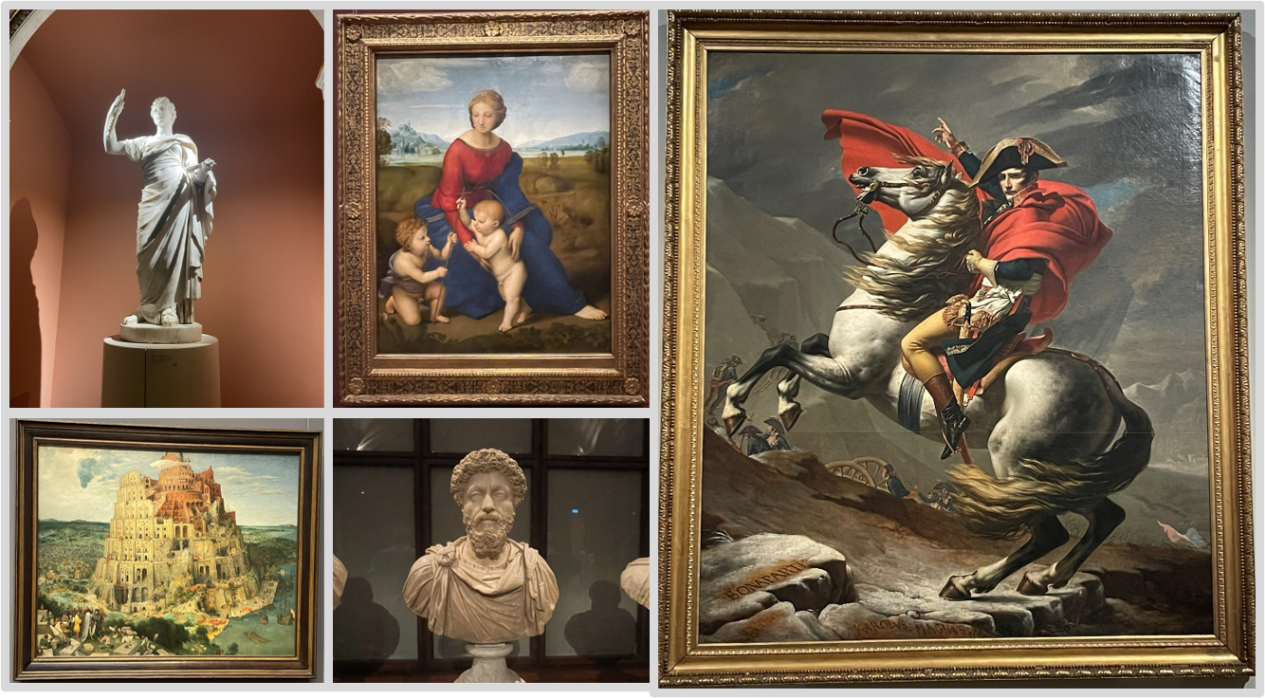
Beyond the academic program, Vienna provided a historical and cultural setting for the conference trip. The Kunsthistorisches Museum offered an extensive view of the Habsburg imperial collections. Its architecture, painting galleries, and ancient collections created a sharp contrast with the technical atmosphere of the conference venue. The museum visit was included in the trip report not as a separate tourist activity, but as part of the broader experience of Vienna as a city shaped by art, collection, empire, and public institutions.
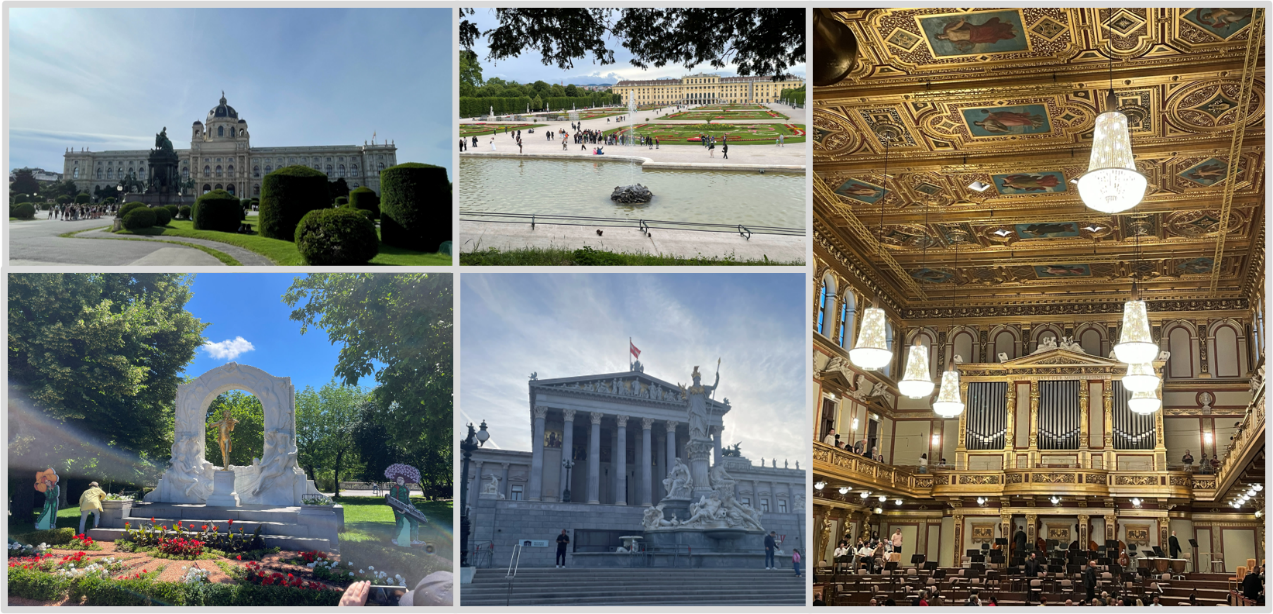
The Belvedere presented another side of Vienna. Built as a Baroque palace complex and now used as an art museum, it connects imperial architecture with Austrian art, including works from the period of Viennese modernism. The contrast between the palace space and the modern paintings displayed inside provided useful visual material for the report. Together with the Kunsthistorisches Museum, it showed how Vienna’s cultural landscape is structured through both imperial history and modern artistic development.
A visit to Carnuntum added an older historical layer. Carnuntum was an important Roman site east of Vienna, associated with the Danube frontier and the Roman province of Pannonia. The reconstructed Roman quarter, archaeological remains, and open landscape offered a concrete view of Roman presence along the Danube. For a visitor interested in ancient Roman history, Carnuntum connected present-day Austria with the military, administrative, and urban networks of the Roman Empire. Photographs from the site can serve as a useful complement to conference images, showing that the trip combined robotics research with a broader encounter with European history.
Music was another important part of the Vienna experience. The trip included concerts at the Wiener Konzerthaus and in the Golden Hall of the Musikverein. The Golden Hall is one of Vienna’s best-known concert spaces and is closely associated with the city’s classical music tradition. For someone with long-term training in violin and viola, hearing an orchestra in these halls was a direct encounter with a musical culture that is often known only through recordings and textbooks. These photographs and notes can be placed near the end of the report to show the cultural dimension of the visit.
Overall, the trip to ICRA 2026 combined academic presentation, technical observation, and cultural experience. On the research side, the conference highlighted several directions relevant to tactile robotics: multimodal tactile hardware, tactile feedback for manipulation, real-world policy refinement, and the connection between tactile recognition and action. On the presentation side, the poster session provided an opportunity to communicate a tactile recognition framework to an international audience. On the cultural side, Vienna offered historical and artistic contexts through museums, music halls, and Roman archaeological remains. The experience formed a compact but substantial international exchange centered on robotics, touch, and the physical interaction between machines and the world.
Hongliang Zhao
Jun 16, 2026.
